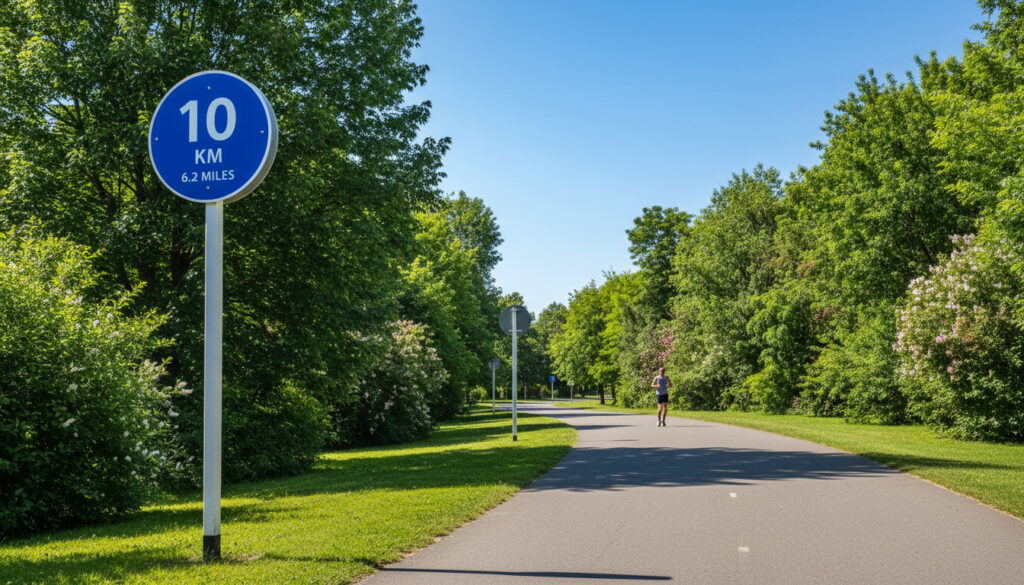
How Many Miles Is 10K – Exact Conversion and Runner’s Guide
Ten kilometers equals exactly 6.21371 miles. Runners and event organizers typically round this figure to 6.2 miles for practical training schedules and race logistics.
The 10K distance represents one of the most universally recognized benchmarks in road racing. It demands greater endurance than a 5K while remaining accessible to recreational athletes, serving as a gateway to longer half-marathon and marathon events.
Precise conversion between metric and imperial units allows athletes to synchronize training plans across different measurement systems and accurately interpret GPS device readouts during workouts.
How Many Miles is 10K?
- The international standard defines 1 kilometer as exactly 0.621371192 statute miles according to conversion algorithms.
- One statute mile equals exactly 1,609.344 meters under the International System of Units (SI).
- USA Track & Field and World Athletics recognize 10K road races as precisely 10,000 meters.
- Training applications universally adopt the 6.2-mile approximation for simplicity.
- The distance doubles the standard 5K race length.
- Olympic track competition includes a 10,000-meter event equivalent to the road 10K.
- Consumer GPS devices may display minor variations due to satellite signal accuracy rather than course measurement error.
| Distance | Kilometers | Miles (Exact) | Common Use |
|---|---|---|---|
| 1 km | 1 | 0.621371 | Base unit |
| 5K | 5 | 3.10686 | Entry race |
| 10K | 10 | 6.21371 | Standard race |
| 10 miles | 16.0934 | 10.000 | Imperial equivalent |
| Half Marathon | 21.0975 | 13.109 | Intermediate |
| Marathon | 42.195 | 26.219 | Long distance |
How Far is 10K in Miles for Running?
Racing Standards
World Athletics and USA Track & Field mandate that certified 10K courses measure exactly 10,000 meters. Race directors use calibrated bicycles and steel tape measurements following international guidelines to ensure precision.
Athletes should understand that GPS wristwatches often record distances slightly longer than the certified length due to zigzag running patterns and signal drift, not because the course exceeds 6.21371 miles.
World Athletics requires road courses to be measured precisely at 10,000 meters. Certified races guarantee the distance meets international standards, though your GPS watch may read slightly differently due to satellite drift.
Training Applications
Coaches program workouts using the 6.2-mile figure for simplicity. A runner completing 10 kilometers in 50 minutes achieves approximately an 8:03-minute-per-mile pace, calculated by converting the kilometer pace to miles using the factor 1.609344.
How to Convert 10K to Miles
The Precise Formula
The exact conversion multiplies kilometers by 0.621371192. Calculation tools apply this factor to determine that 10 km × 0.621371192 = 6.21371192 miles.
This factor derives from the definition of one statute mile as exactly 1,609.344 meters. Therefore, one kilometer (1,000 meters) divided by 1,609.344 meters equals 0.621371192 miles.
Multiply kilometers by 0.62 for a fast estimate. For 10K, 10 × 0.62 = 6.2 miles instantly. For greater precision, use 0.6214.
Quick Estimation Methods
Online calculators provide instant results by applying the standard factor. Athletes can also remember that 5 kilometers approximates 3.1 miles, making 10 kilometers roughly double at 6.2 miles.
Avoiding Conversion Errors
A common mistake involves confusing 10K with 10 miles. Ten miles equals approximately 16.09 kilometers, making it 60% longer than a 10K race. This distinction proves critical when selecting training plans or interpreting race distances.
Ten kilometers differs significantly from 10 miles. Ten miles equals approximately 16.09 kilometers—over 60% longer than a 10K race.
When Did the 10K Become a Standard Distance?
- 1960s: International System of Units standardization establishes the kilometer as a global measurement base, replacing various national standards.
- 1970s: The running boom popularizes 10K road races across the United States and Europe, establishing the distance as a recreational benchmark.
- Present: World Athletics and USA Track & Field certify thousands of 10K courses annually using precise measurement protocols.
What is Exact vs. Approximate in 10K Conversions?
| Established Facts | Uncertain or Variable Information |
|---|---|
| 1 km = 0.621371192 miles (international standard) | Exact step count for 10K (varies by stride length: 12,000–15,000 running, 14,000–18,000 walking) |
| 10K = 6.21371 miles exactly | Caloric burn for 10K (varies by weight, pace, and metabolism) |
| 10K = 10,000 meters by definition | GPS measurement error margins (±1–3% typical) |
| NIST recognizes the 0.621371192 conversion factor in technical publications | Individual finishing times for specific fitness levels |
How is 10K Used in Training and Competition?
Running a 10K typically requires 30 to 60 minutes depending on pace, while walking the distance demands 90 to 120 minutes. This duration makes the 10K an ideal aerobic threshold workout for marathoners and a primary goal for beginners.
The distance serves as a logical progression between the 5K and half-marathon, allowing runners to develop stamina without the recovery demands of longer events. Internationally, races use kilometer markings, though some U.S. events display mile splits for local participants.
Where Do 10K Standards Originate?
1 kilometer = 0.621371192237 statute miles
National Institute of Standards and Technology (NIST) conversion standards
NIST Handbook 44 provides the legal framework for measurement precision in the United States, though practical conversions often round to 0.62 for public use. World Athletics maintains the competitive standards for road racing, ensuring that 10K events worldwide measure exactly 10,000 meters regardless of local measurement customs.
What Should You Remember About 10K Distances?
Ten kilometers translates to exactly 6.21371 miles, though the running community universally adopts 6.2 miles for training and racing purposes. This distance bridges recreational fitness and competitive athletics, standardized globally by World Athletics and precisely defined by international metric conventions. For converting other distances, consult a dedicated conversion tool.
Frequently Asked Questions
Is 10K exactly 6.2 miles?
Ten kilometers equals exactly 6.21371 miles. The figure 6.2 miles represents a rounded approximation commonly used in training plans and race descriptions for simplicity.
How long does it take to walk 10K?
Walking 10K typically requires 90 to 120 minutes at a brisk pace of 15 to 20 minutes per mile. Individual times vary based on walking speed, terrain, and rest stops.
Is a 10K harder than a 5K?
Yes. A 10K requires twice the distance of a 5K, demanding greater aerobic endurance and pacing discipline. While the intensity is lower than a 5K sprint, the sustained effort challenges muscular stamina.
How do I convert 10K pace to minutes per mile?
Multiply your minutes-per-kilometer pace by 1.609344. For example, a 5:00 per kilometer pace equals approximately 8:03 per mile.
What’s the difference between 10K and 10 miles?
Ten kilometers equals 6.21371 miles, while 10 miles equals 16.09 kilometers. Ten miles is approximately 3.8 miles longer than a 10K—nearly 60% more distance.
Why do some races use kilometers and others use miles?
International races use kilometers under SI standards. Some U.S. events use miles due to historical measurement customs, though most major races now display both units.
How many steps are in a 10K?
Running a 10K typically requires 12,000 to 15,000 steps depending on stride length. Walking the same distance usually requires 14,000 to 18,000 steps due to shorter walking strides.
More related posts
 Big Bang Theory Penny: Myths, Health & Character Guide
 How Old Is Sabrina Carpenter? Age, Birthday, Height
 Tyrique George: Collapsed Transfer, Everton Move & Salary
 Max Thieriot: Why He Left SEAL Team, Wife Lexi, Fire Country
 Jet Li health: hyperthyroidism, net worth, and his acting retirement
 Josh Pugh Disability: Comedian, Para-Footballer & Marriage
 Nike Air Force 1 Low: Ireland Guide, Prices & Styles
 John Lowe: Darts Career Earnings, Net Worth & Retirement
