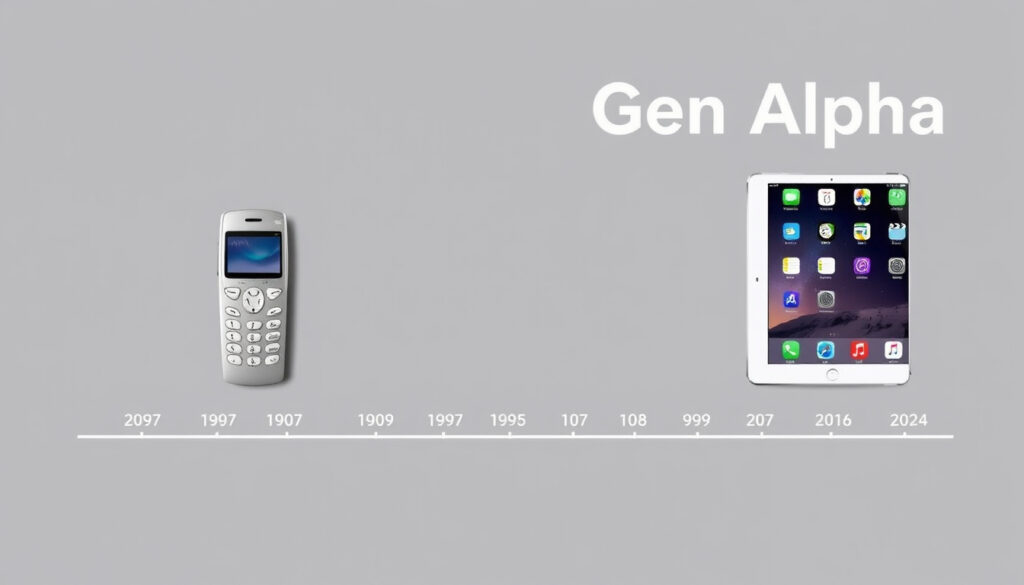
Gen Alpha Birth Years: What Age and Differences From Gen Z
Few things spark as much confusion as generational boundaries — especially when the oldest members of Generation Alpha are just now entering their teenage years. With birth years spanning 2010 to 2024, Gen Alpha is the first cohort born entirely in the 21st century, and in 2025 its oldest members are 15 years old (Britannica (encyclopedia reference)).
Gen Alpha birth years: 2010 to 2024 ·
Oldest Gen Alpha age (2025): 15 years old ·
Youngest Gen Alpha age (2025): 1 year old ·
Gen Z birth years: 1997 to 2012 ·
Gen Beta start year: 2025 (projected)
Quick snapshot
- Gen Alpha born 2010-2024 per McCrindle (Britannica)
- Gen Z defined as 1997-2012 by Pew Research (Pew Research Center (nonpartisan fact tank))
- Oldest Gen Alpha is 15 in 2025 (Britannica)
- Whether 2010 is definitively Gen Alpha or Gen Z under some schemes (Mental Floss (popular culture magazine))
- Official names for generations after Gen Beta (Wikipedia (community encyclopedia) notes no consensus)
- Gen Delta age boundaries (no consensus) (Wikipedia)
- Gen Alpha: 2010-2024 (McCrindle) (USA Today (national news outlet))
- Gen Beta projected: 2025-2039 (USA Today (national news outlet))
- Oldest Gen Alpha turns 16 in 2026 (USA Today (national news outlet))
- Gen Beta begins 2025
- Gen Alpha will be the parents of Gen Beta
- Naming beyond Beta remains speculative
Five key facts, one pattern: the boundary between Gen Z and Gen Alpha is fuzzy, but the most widely used definitions give a clear picture.
| Label | Value |
|---|---|
| Gen Alpha birth years | 2010 to 2024 |
| Oldest Gen Alpha in 2025 | 15 years old |
| Youngest Gen Alpha in 2025 | 1 year old |
| Gen Z birth years | 1997 to 2012 |
| Gen Beta start year | 2025 (projected) |
Is 2010 Gen Z or Gen Alpha?
The birth year cutoff between Gen Z and Gen Alpha
- Pew Research Center defines Generation Z as anyone born from 1997 onward, after setting 1996 as the last Millennial birth year (Pew Research Center (nonpartisan fact tank)). This means a person born in 2010 falls under Gen Z according to Pew’s 2019 definition.
- However, McCrindle Research, the source most commonly cited for the term Generation Alpha, uses 2010 as the start year (Britannica).
- The Library of Congress consumer research guide lists Generation Alpha as spanning the 2010s and 2020s (Library of Congress (U.S. federal library)).
Why 2010 is considered Gen Alpha by most demographers
- USA Today reported Generation Alpha as those born between 2010 and 2024 (USA Today).
- Mental Floss notes that the ranges are still debated, with common bounds of early 2010s to 2024 or 2025 (Mental Floss).
- Wikipedia summarizes the lack of consensus on Generation Alpha birth years (Wikipedia).
A 14-year-old in 2025 (born 2010-2011) is classified as Gen Alpha by McCrindle and most media outlets, but strictly under Pew’s 2019 definition that same teen would be Gen Z. The conflict is real, and it matters for marketers, educators, and policymakers who rely on consistent cohort labels.
The implication: if you were born in 2010, you are most commonly called Gen Alpha, but the Pew definition has not been updated to reflect the newer naming convention. The trade-off: older sources (pre-2020) will label 2010-borns as Gen Z; newer sources almost universally call them Gen Alpha.
What is Gen Z vs Gen Alpha?
To see the differences at a glance, here is a side-by-side comparison of the two generations.
| Generation | Birth years | Age in 2025 |
|---|---|---|
| Gen Z | 1997-2012 | 13-28 |
| Gen Alpha | 2010-2024 | 0-15 |
| Overlap zone | 2010-2012 | 13-15 |
Key differences in birth years
- Gen Z: born 1997-2012, digital natives who remember a pre-smartphone era (Pew Research Center).
- Gen Alpha: born 2010-2024, first fully 21st-century generation (Britannica).
- The overlap zone (2010-2012) is the source of confusion: those years belong to Gen Z under Pew but to Gen Alpha under McCrindle.
Cultural and technological differences between generations
- Gen Z grew up during the rise of social media and smartphones; they remember a world without TikTok.
- Gen Alpha is more screen-native and AI-native, with some toddlers using tablets before speaking (USA Today).
- Oldest Gen Alpha in 2025 are 15-year-olds, entering high school with a fully digital upbringing.
What this means: the Gen Alpha experience is fundamentally different from Gen Z’s — no memory of a world without streaming, AI, or the COVID-19 pandemic that shaped their early schooling.
What age is a Gen Alpha?
Age ranges for Gen Alpha in 2025
- Gen Alpha ages 0 to 15 in 2025 (born 2010-2024).
- The oldest Gen Alpha will turn 16 in 2026.
- Gen Beta is expected to start in 2025 and extend to ~2039 (Britannica).
When Gen Alpha ends and Gen Beta begins
- McCrindle’s 2010-2024 range implies 15 birth years for Gen Alpha.
- Britannica’s 2010-2025 range extends into 2025, but most sources use 2024 as the end year.
- USA Today’s 2024 framing means newborns in 2024 are still Gen Alpha (USA Today).
Parents and educators need to know that a child born in 2024 is Gen Alpha, not Gen Beta — and that the youngest Alphas will be in elementary school when the oldest Betas are born. Mislabeling can affect cohort-based curriculum design and marketing strategies.
The pattern: expect Gen Beta to be defined as births from 2025 onward, following the Greek alphabet convention that McCrindle established.
What is after Gen Beta?
Current naming for generations after Gen Beta
- Gen Beta follows Gen Alpha, projected 2025-2039.
- Some use Gen Gamma and Gen Delta for hypothetical future generations, but there is no official consensus (Wikipedia).
- Cambridge Dictionary added “Gen Alpha” to its corpus in 2025, describing it broadly as people born during the 2010s and 2020s (Wikipedia summary of Cambridge Dictionary addition).
Gen Delta and future generation naming conventions
- No official body has defined Gen Delta or any generation beyond Gen Beta.
- Demographers typically use Greek letters (Alpha, Beta, Gamma, Delta) but the naming is not regulated.
The trade-off: any article that confidently names Gen Delta is speculative. The only certainty is that Gen Beta will start in 2025 and will be the children of Gen Z parents.
What is the unhappiest generation?
Research on generational happiness trends
- Surveys indicate Gen Z reports lower happiness than older generations, with economic factors and social media cited as contributors (Pew Research Center).
- Gen Alpha is too young for reliable happiness surveys — the oldest are only 15.
- Some researchers label Gen Alpha as “Generation Covid” due to the pandemic’s impact on their early development (Library of Congress).
Gen Z vs Millennials vs Gen Alpha wellbeing data
- Millennials and Gen X report higher life satisfaction than Gen Z in multiple studies.
- Gen Alpha’s wellbeing will be a key research area as they enter adolescence.
What this means: the “unhappiest generation” label currently belongs to Gen Z, but Gen Alpha’s mental health trajectory is still unknown and will be shaped by the digital environment they are born into.
Timeline: Generational milestones
- 1997-2012 — Gen Z birth years (Pew Research Center definition) (Pew Research Center)
- 2010-2024 — Gen Alpha birth years (McCrindle definition) (Britannica)
- 2025 — Gen Beta begins (projected); oldest Gen Alpha turns 15
- 2025-2039 — Gen Beta projected birth years
Clarity: What we know and what we don’t
Confirmed facts
- Gen Alpha defined by McCrindle as 2010-2024 (Britannica)
- Gen Z ends at 2012 per Pew Research (Pew Research Center)
- A 14-year-old in 2025 (born ~2011) is Gen Alpha under the dominant definition
What’s unclear
- Whether 2010 is absolutely Gen Alpha or Gen Z under some expert schemes (Mental Floss)
- Official names for generations beyond Gen Beta (Wikipedia)
- Gen Delta age boundaries (no consensus) (Wikipedia)
Expert perspectives
“Generation Alpha are those born from 2010 to 2024, the first generation born entirely in the 21st century.”
— Mark McCrindle, demographer who coined the term Generation Alpha (Britannica)
“Generation Z includes anyone born after 1996, with the oldest members turning 22 in 2019.”
— Pew Research Center, nonpartisan fact tank (Pew Research Center)
“The ranges are still debated, but common bounds for Gen Alpha are early 2010s to 2024 or 2025.”
— Mental Floss, popular culture magazine (Mental Floss)
For parents, educators, and marketers trying to understand the youngest generation, the choice is clear: use the McCrindle/Britannica definition of 2010-2024 for Gen Alpha, acknowledge the Pew overlap, and prepare for Gen Beta in 2025. Mislabeling a 14-year-old as Gen Z instead of Gen Alpha may seem trivial, but it affects everything from classroom materials to advertising targeting — and the confusion will only grow as Gen Alpha enters adulthood.
Related reading: Where’s Wally? Origin, Name Changes, and Bans · Blood Type Rarity: AB Negative, Irish & Jesus Facts
pew.org, wytv.com, iienstitu.com, pew.org, pew.org, whatismygen.com, avstamp.se
Frequently asked questions
What is the exact age range of Gen Alpha?
Gen Alpha is commonly defined as those born between 2010 and 2024, making them 0 to 15 years old in 2025 (Britannica).
How old is the oldest Gen Alpha in 2025?
The oldest Gen Alpha members are 15 years old, born in 2010 (Britannica).
What generation comes after Gen Alpha?
Gen Beta is projected to start in 2025 and extend to approximately 2039 (Britannica).
Under which definition are people born in 2010 considered Gen Z?
Under Pew Research’s 2019 definition, 2010 falls within Gen Z. However, most current sources classify 2010 as Gen Alpha (Pew Research Center).
What are the key differences in birth years and cultural traits between Gen Alpha and Gen Z?
Gen Z (1997-2012) grew up with the rise of smartphones and social media, while Gen Alpha (2010-2024) is the first generation born entirely in the 21st century, with AI and streaming as a baseline (USA Today).
What are the main characteristics of Generation Alpha?
Gen Alpha is the most digitally immersed generation yet, with many using tablets before age 2. They are growing up with AI assistants, streaming services, and the lasting effects of the COVID-19 pandemic on their early education (USA Today).
More related posts
 How Old Is Sabrina Carpenter? Age, Birthday, Height
 Is Vaping Bad for You? Risks, Lung Healing & Comparison
 Sports Direct Near Me – Store Locator, Hours and UK Locations
 Kate Moss: Net Worth, Relationships, Sobriety & Career Timeline
 Best Phone Case Guide: Brands, Types & Prices for Ireland
 Annabelle Wallis: Verified Facts, Tom Cruise Kiss & Career
 Bernese Mountain Dog Puppy – Cost Size Care Training Guide
 Linda Bassett: Age, Husband, Wigs, Roles | Call the Midwife
