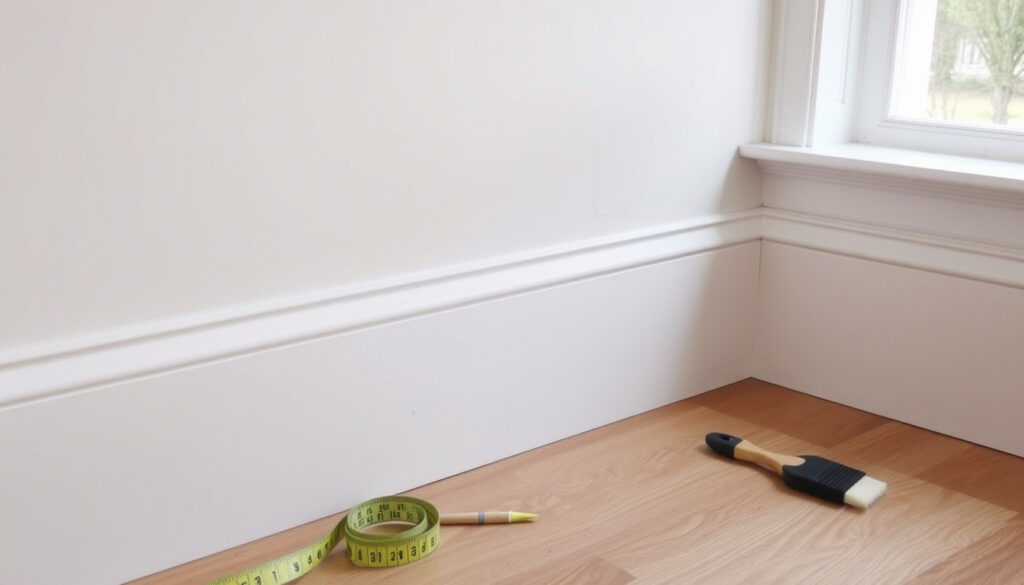
Skirting Board Guide: Types, Installation, Costs & FAQs
Few home improvement jobs look as straightforward as fitting a skirting board — until you’re on your knees with a mitre saw and a piece that’s 3 mm too short. Between protecting walls from scuffs and hiding the expansion gap that floating floors need, a well-fitted skirting board quietly does a lot. This guide breaks down the materials, the methods, and the real costs, with a focus on the Irish market and the DIY-versus-professional trade-off every homeowner faces.
Standard skirting board height range: 100–200 mm · Most common material: MDF · DIY installation time for an average room: 2–4 hours · Average carpenter cost per linear metre (UK/Ireland): £15–£25 / €15–€25 · Typical board length: 2.4–3.0 m
Quick snapshot
- Protects walls from damage (B&Q fitting guide (UK retailer))
- Hides floor‑wall expansion gap (Flooring Surgeons (trade blog))
- Can you live without? – possible but not recommended (NearMeTrades (trade matching platform))
- MDF: budget‑friendly, paintable (MDF Skirting World (specialist retailer))
- Solid wood: durable, stainable (Woodlane Timber (timber supplier))
- PVC: waterproof, easy to clean (B&Q (DIY retailer))
- DIY possible with mitre saw and adhesive (Woodlane Timber (timber supplier))
- Nailing for straight walls (Bunnings (hardware retailer))
- Carpenter cost: £15–25 per metre, typical room £150–300 (NearMeTrades (trade matching platform))
- Shadow gaps for minimalist look (Better Homes & Gardens Australia (home magazine))
- LED skirting boards (Flooring Surgeons (trade blog))
- Modern materials: aluminium, acrylic (Materials Market (building supplies retailer))
Four key numbers define the skirting‑board buying decision — dimensions, material dominance, board lengths, and labour rates.
| Specification | Typical Value | Source |
|---|---|---|
| Average skirting board height | 100–200 mm | Woodlane Timber |
| Most popular material in Ireland | MDF (Chadwicks, Woodie’s) | MDF Skirting World |
| Standard board length sold | 2.4 m or 3.0 m | B&Q |
| Typical carpenter fitting cost per linear metre | €15–€25 | NearMeTrades |
The 100–200 mm range isn’t just aesthetic — it determines how much expansion gap you can hide. A taller board covers bigger gaps left by thicker floating floors, saving you the cost of scribing or adding a separate trim.
What is the purpose of a skirting board?
Protecting the wall from damage
- Skirting boards absorb kicks, vacuum cleaner bumps, and furniture scuffs that would otherwise mark plaster (B&Q fitting guide).
- In high‑traffic areas like hallways, a hard‑wearing board (PVC or oak) can eliminate the need for frequent wall repairs.
Hiding the gap between wall and floor
- Solid wood and laminate floors require an expansion gap of 10–15 mm to allow for seasonal movement (Flooring Surgeons).
- The skirting board covers that gap neatly, leaving a clean visual line.
Adding visual finish to a room
- Proportioned skirting boards act as a transition between wall and floor finishes, framing the room (Better Homes & Gardens Australia).
The implication: skirting boards serve a functional purpose beyond decoration, making them a necessary element in most rooms.
What type of skirting board is best?
MDF skirting boards: pros and cons
- Cost‑effective and paint‑ready straight from the shop (MDF Skirting World).
- Can swell if exposed to standing water — avoid in bathrooms without proper sealing.
Solid wood skirting boards: oak, pine, redwood
- Durable, can be stained or varnished, and holds screws better than MDF (Woodlane Timber).
- More expensive per metre and prone to expansion/contraction with humidity changes.
PVC / duropolymer skirting boards (waterproof)
- Waterproof and impact‑resistant, ideal for kitchens and bathrooms (B&Q).
- Available in pre‑finished white; harder to paint if you want a custom colour.
Choosing based on room and budget
- MDF for dry living rooms and bedrooms on a budget; solid oak for period properties; PVC for wet zones.
- For Irish homes with high humidity, PVC or primed MDF with moisture‑resistant primer is a safe bet.
Three materials, one trade‑off: upfront cost versus long‑term durability and moisture resistance.
| Attribute | MDF | Solid Wood (Oak/Pine) | PVC / Duropolymer |
|---|---|---|---|
| Cost per linear metre (material only) | €3–8 | €10–25 | €8–15 |
| Durability | Medium – can chip | High – can be sanded | High – impact resistant |
| Water resistance | Low – swells | Medium – may warp | High – fully waterproof |
| Paintability | Excellent – ready to paint | Good – needs priming | Poor – limited to factory finish |
| Ease of cutting | Easy – dust, but clean cuts | Moderate – splintering risk | Easy – use fine‑tooth saw |
| Typical room use | Living rooms, bedrooms | Halls, period homes | Kitchens, bathrooms, rentals |
For a standard Irish three‑bed semi‑detached (≈ 80 linear metres of skirting), switching from MDF to solid oak adds €500–1,000 in material cost alone. Most homeowners stick with MDF and save the budget for proper primer and paint.
Upsides
- DIY‑friendly – no specialist training needed with a mitre saw
- Wide choice of profiles and sizes from any builders’ merchant
- Low material cost for MDF – typical room €120–200
Downsides
- MDF swells if wet – risk in Irish bathrooms without extractor
- Perfect mitres require practice – mistakes cost time and material
- Stud walls hide fixings – a stud finder is non‑negotiable
Can I install skirting boards myself?
Tools required for DIY installation
- Mitre saw (or mitre box with hand saw), tape measure, pencil, adhesive (grab adhesive or No More Nails), caulking gun, nail gun or hammer and finishing nails, sander, filler/paint (Woodlane Timber).
- Stud finder for fixing into stud walls (Better Homes & Gardens Australia).
Step‑by‑step: measuring, cutting, fitting
- Measure each wall twice — length, internal/external corners identified — and mark each board by position (Flooring Surgeons).
- Cut internal corners with a scribed joint for tighter fit; external corners at 45 degrees (Better Homes & Gardens Australia).
- Dry‑fit the boards — adjust and recut if gaps are visible (Bunnings).
- Apply construction adhesive to the back of the board and press into place. For long runs, use additional nails or brad nails every 40–60 cm (Battiscopa (skirting trade supplier)).
- Fill nail holes with wood filler; sand smooth; then caulk the top edge and corners (NearMeTrades).
- Prime and paint (or stain if using solid wood) for a finished look.
Glue vs nail: which method to use?
- Adhesive alone works on smooth, clean walls and short runs (Materials Market).
- Nails or screws are essential on uneven walls, long runs, or where the board needs to be pulled tight to the wall (pilot holes and wall plugs for masonry) (Better Homes & Gardens Australia).
Common mistakes to avoid
- Cutting all boards before dry‑fitting — slight wall variations mean dimensions differ per wall.
- Forgetting to account for the flooring thickness when setting board height.
- Not cleaning the wall surface before applying adhesive — dust kills bond strength.
The catch: while DIY is possible, the quality of the finish depends heavily on the condition of your walls and your skill with a mitre saw.
Should skirting boards be flush with the floor?
Why a gap under the skirting board is sometimes needed
- Floating floors (laminate, LVT, engineered wood) require an expansion gap of 10–15 mm around the perimeter to prevent buckling (Flooring Surgeons).
- The skirting board is fitted after the floor is laid, covering that gap — no gap visible on the finished job.
Expansion gap for flooring materials
- Solid wood floors: 15–20 mm gap. Carpet: no gap needed. Tile: 5–10 mm (Bunnings).
How to adjust skirting board height after flooring installation
- If you fit skirting before the floor, leave a gap equal to the flooring thickness + 10–15 mm, then pack up the boards with spacers (Materials Market).
- Alternatively, fit after flooring and scribe the bottom of the board to follow floor level (for uneven floors).
In Ireland, many houses have concrete subfloors with screed that can vary by 5–10 mm across a room. Scribing the skirting to the floor avoids an ugly gap — but it’s a skilled job that pushes most DIYers to hire a carpenter.
What this means: the decision to scribe or leave a gap depends on the flooring type and the evenness of the floor surface.
What is the modern alternative to skirting boards?
Baseboard‑less designs and shadow gaps
- Shadow gap systems leave a recess between wall and floor — no physical board, just a clean, minimalist line (Better Homes & Gardens Australia).
- Require precise plastering and a gap former; cost more than MDF skirting.
LED integrated skirting
- Boards with built‑in LED strips for ambient lighting — popular in media rooms and modern bedrooms (Flooring Surgeons).
- Installation is electrical‑rated — usually not a DIY job.
Acrylic and metal profiles
- Aluminium or stainless steel skirting suits commercial and industrial‑style interiors (Materials Market).
- More expensive, less forgiving of wall imperfections.
Painable wall trims vs traditional skirting
- Simple square‑edge MDF strips that mimic shadow gaps but cost less.
- Best for contemporary homes where no ornate profile is needed.
Alternatives like shadow gaps and LED skirting add visual flair but can double the per‑metre cost. For most Irish homes, a traditional MDF or PVC board remains the most practical balance of cost, durability, and ease of installation.
Confirmed facts
- Skirting boards cover expansion gaps and protect walls from scuffs
- MDF is the most common material due to cost and paintability (MDF Skirting World)
- A gap under the skirting is required for floating floors (Flooring Surgeons)
- DIY installation is feasible with basic tools (Woodlane Timber)
What’s unclear
- Exact average cost per metre can vary by region and carpenter — published ranges are indicative, not guaranteed (NearMeTrades)
- Long‑term durability of PVC vs wood in the Irish climate is not authoritatively documented in independent trials
The implication: modern alternatives offer aesthetic benefits but come with higher costs and installation complexity, making traditional materials the pragmatic choice for most budgets.
“Most people underestimate how much the wall finish matters. A clean wall with good paint will make even basic MDF skirting look high‑end. The trick is the caulking — a tidy bead along the top edge elevates the whole room.”
— Industry expert, Murphy Larkin (skirting board supplier)
“The biggest mistake I see on call‑outs is people cutting all the boards at once without checking the walls. Every wall is a tiny bit different. Dry‑fit everything before you glue. If you’ve already cut, you can’t fix a 5 mm gap.”
— Professional carpenter, quoted on NearMeTrades
“For bathrooms, I always recommend PVC or primed MDF with a moisture‑resistant primer. A cheap MDF board in a steamy bathroom will start swelling within six months.”
— Industry expert, Murphy Larkin (skirting board supplier)
The data is clear: MDF dominates the Irish market because it delivers an acceptable look at a low price. But the decision between DIY and professional fitting has a real arithmetic. For an average 80‑metre semi‑detached, the labour saving of going DIY is roughly €1,200–2,000 — enough to upgrade from MDF to PVC or to invest in better tools. For homeowners who already own a mitre saw and have a weekend free, the choice is obvious. For those who value time and perfect mitres, paying the carpenter is the smarter cost.
Related reading
- Shipping Container: Types, Lifespan, and Planning Rules — broader construction and planning context for home improvement projects.
- Vueling Airlines Review 2025 — another practical guide format from the same site.
youtube.com, blog.toolden.co.uk, myjobquote.co.uk, colombiareportes.net
Frequently asked questions
How do I cut skirting boards for internal and external corners?
Internal corners are best cut with a scribed joint: cut one board square and the other at 45° with the back cut longer to match the profile. External corners: cut both boards at 45°. Use a mitre saw for accuracy. (Woodlane Timber)
What tools do I need to install skirting boards?
Mitre saw (or hand mitre box), tape measure, pencil, grab adhesive, caulking gun, nail gun or hammer + finishing nails, sandpaper, filler, paint. A stud finder helps for stud walls. (Bunnings)
Should skirting boards match architrave?
Yes — the same material, profile, and finish create a cohesive look around doors and floor. Most builders’ merchants sell matching sets. Mixing styles can look disjointed in traditional homes.
How to paint skirting boards for a professional finish?
Sand lightly, wipe dust, apply one coat of primer, caulk the top edge and corners, then apply two coats of satin or eggshell paint. Use a small roller for the flat face and a brush for the top edge. (Materials Market)
Can I use skirting boards with underfloor heating?
Yes — MDF and wood work fine as long as the heating is not directly under the board. PVC may expand more with heat. Keep the expansion gap next to the floor, not the wall.
How to repair damaged skirting boards?
Small dents and holes: fill with wood filler, sand, and repaint. Chipped edges: apply filler, shape with a damp finger, sand. Severe damage: replace the damaged section by cutting it out and splicing in a new piece with adhesive and nails. (Better Homes & Gardens Australia)
What is the difference between skirting board and baseboard?
In the UK and Ireland, “skirting board” is the standard term; “baseboard” is used in North America. They refer to the same product: a board fixed to the bottom of an interior wall. Profile styles differ regionally.
More related posts
 Matthew Macfadyen: Biography, Movies, Wife, and Accent
 Mr Motivator: What He Does Now, Net Worth, Wife, and More
 Shirley MacLaine: Health, Love Life, and Family – 2024 Update
 Diane Keaton Death: Pneumonia, Life, and Legacy
 Bonnie and Clyde True Story: Facts, Myths, and Final Hours
 Sausage Dogs: Dachshund Breed Guide & Care Tips
 Taylor Frankie Paul: Health, Relationships, and Family Updates
 Local Handyman Near Me: Ireland Platforms & Prices
