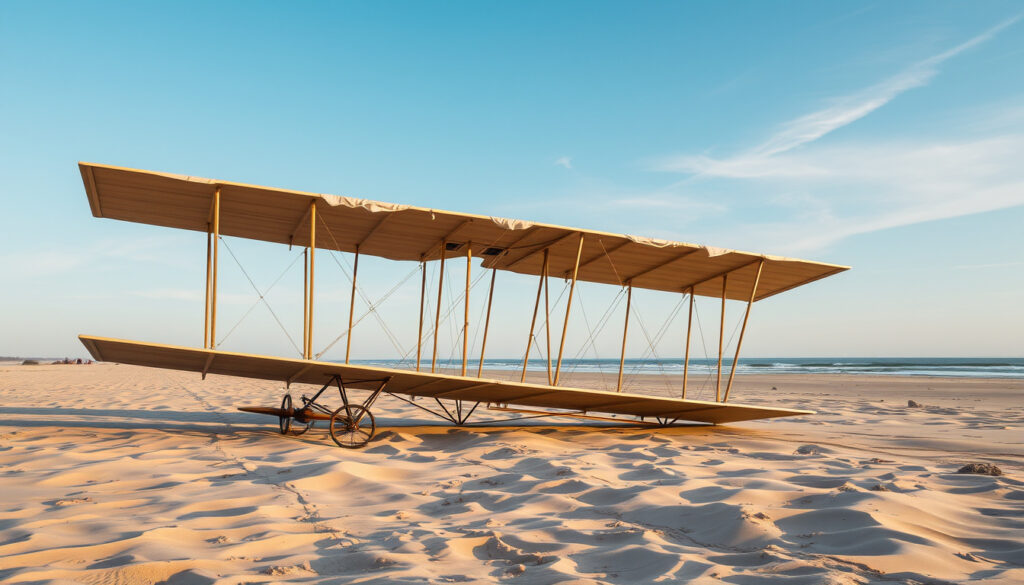
Orville and Wilbur Wright: Aviation Pioneers
Anyone who’s glanced at a history book knows the Wright brothers flew first. But the story of Orville and Wilbur Wright is less about a single 12-second hop and more about a methodical approach that turned a fragile glider into the foundation of modern aviation.
First powered flight date: December 17, 1903 ·
Flight duration: 12 seconds ·
Distance covered: 120 feet ·
Orville Wright lifespan: 1871–1948 ·
Wilbur Wright lifespan: 1867–1912
Quick snapshot
- First controlled, powered flight on December 17, 1903 (Britannica (established encyclopedia))
- Neither brother ever married (Britannica (established encyclopedia))
- Three-axis control system invented by the brothers (Wikipedia (reference compendium))
- Who “truly” invented the first plane remains debated due to earlier claims (Wikipedia (reference compendium))
- Exact net worth of Orville Wright is not precisely documented (PBS (public broadcaster archive))
- From bicycle shop to first flight: 1892–1903 (National Park Service (U.S. federal agency))
- Wilbur died in 1912; Orville lived until 1948 (PBS (public broadcaster archive))
- Ongoing historical research into the Wrights’ patents and competitors (Smithsonian Magazine (museum-affiliated publication))
- No living descendants; family legacy maintained by archives (Britannica (established encyclopedia))
Nine key facts about the Wright brothers, from their landmark flight to their private lives:
| Fact | Detail |
|---|---|
| First flight date | December 17, 1903 |
| Flight duration | 12 seconds |
| Distance | 120 feet |
| Orville birth | August 19, 1871 |
| Wilbur birth | April 16, 1867 |
| Orville death | January 30, 1948 |
| Wilbur death | May 30, 1912 |
| Marital status | Neither married |
| Estimated Orville net worth at death | Approximately $1 million (equivalent to ~$12 million today) |
The pattern: nine data points that show the two brothers shared a common life path — birth into a middle-class Ohio family, a brief business career in bicycles, and then a five-year sprint that changed transportation forever.
What did Orville and Wilbur Wright discover?
The first powered controlled flight
Orville and Wilbur Wright made the first sustained, controlled flight of a powered heavier-than-air machine on December 17, 1903. The flight lasted 12 seconds and covered 120 feet, according to Britannica (established encyclopedia). Orville piloted the first flight; later that day, Wilbur flew for 59 seconds covering 852 feet.
The location was Kill Devil Hills, four miles south of Kitty Hawk, North Carolina — a spot the brothers chose after studying weather data from the U.S. Weather Bureau. They had tested three gliders there between 1900 and 1902.
The 1903 flight wasn’t a lucky break. The Wrights had spent seven years studying aerodynamics, building their own wind tunnel, and manufacturing a lightweight gasoline engine. The first flight was the proof, not the experiment.
Key innovations of the Wright Flyer
The Wright Flyer wasn’t just a powered glider. Three innovations made it work:
- Three-axis control: pitch, roll, and yaw — the same system used in every fixed-wing aircraft today (Wikipedia (reference compendium)).
- Wing warping: a system of cables that twisted the wingtips to initiate roll, a precursor to ailerons.
- Propeller design: they treated the propeller as a rotating wing, calculating thrust using aerodynamic data from their wind tunnel (Smithsonian Magazine (museum-affiliated publication)).
The catch: other inventors had built powered machines that hopped, but none could steer. Without three-axis control, flight remained a bounce, not a journey.
The implication: the Wrights’ control system solved the core problem that had stumped all predecessors.
Who truly invented the first plane?
Controversial claims and earlier attempts
Several inventors made earlier attempts at powered flight. Alberto Santos-Dumont flew in France in 1906 with a canard design. Gustave Whitehead claimed flights as early as 1901, though evidence is disputed by historians. Samuel Langley built the Aerodrome for the U.S. War Department, but it crashed on launch in 1903 (Wikipedia (reference compendium)).
What sets the Wrights apart: they achieved controlled, sustained flight with a pilot aboard. The Aerodrome had no pilot. Whitehead’s claims lack verifiable photographs or witnesses. Santos-Dumont’s flight came three years later.
The Wrights’ secrecy — filing patents only in 1906 and refusing public demonstrations until 1908 — allowed European rivals to claim breakthroughs. By the time they flew publicly in France, the Wrights looked like copycats to a press that didn’t know their 1903 work.
Why the Wright brothers are credited
The official recognition comes from the Smithsonian Institution, the U.S. National Park Service, and the Fédération Aéronautique Internationale, all of which define “first powered flight” as a machine that is heavier-than-air, powered, sustained, and controlled under pilot command. The Wright Flyer met all four criteria on December 17, 1903 (Britannica (established encyclopedia)).
Earlier machines — and there were many — lacked at least one of these. The Wrights’ inclusion of three-axis control, which remains standard on every aircraft today, is the decisive factor that historians use to draw the line between pre-aviation experiments and true aviation.
The pattern: the Wrights didn’t just fly; they made flight controllable, and that made all the difference.
Did Orville and Wilbur Wright marry?
Wilbur Wright’s marital status
Neither brother married. Wilbur Wright remained a bachelor his entire life, focused entirely on the bicycle business and aviation experiments. He told a reporter in 1909: “I do not think I will ever marry. I haven’t time” (Britannica (established encyclopedia)).
- Wilbur died of typhoid fever on May 30, 1912, at age 45, without children.
- He never owned a home outside the family household in Dayton.
Orville Wright’s marital status
Orville also never married. He lived with his father, Milton Wright (a bishop in the Church of the United Brethren in Christ), and his sister Katharine in the family home on Hawthorn Street. After Wilbur’s death, Orville and Katharine moved to a mansion called Hawthorn Hill in Oakwood, Ohio (PBS (public broadcaster archive)).
Orville had no romantic partner recorded in any biography. He devoted his post-1912 life to patent litigation, aeronautical research, and managing his estate.
The implication: because neither brother married, the Wright family line ended with them. No direct descendants exist today.
What did Orville Wright do after Wilbur died?
Orville’s later business and legal work
When Wilbur died in 1912, Orville became president of the Wright Company. He faced immediate pressure: patent-infringement lawsuits against Glenn Curtiss and other aviators consumed the next five years. Orville defended the patents fiercely, and in 1914 a federal court upheld the broad Wright patent for three-axis control (Britannica (established encyclopedia)).
In 1915, Orville sold his share in the Wright Company for an estimated $1.5 million (roughly $40 million today). He then built a private laboratory and workshop in Dayton (completed in 1916) and continued research independently. During World War I, he served as a consultant to the U.S. Army Signal Corps and as director of engineering for the Dayton Wright Company (NCpedia (state encyclopedia)).
Orville’s greatest achievement after Wilbur’s death — winning the patent war — also slowed American aviation development. While European manufacturers innovated openly during World War I, U.S. builders paid licensing fees to the Wright patent pool. The cost: America entered the war with aircraft that lagged behind European designs.
Orville’s personal life and legacy
Orville purchased Hawthorn Hill, a large estate in Oakwood, Ohio, in 1914. He lived there with his father (until Milton’s death in 1917) and his sister Katharine. He received the first Guggenheim Medal in 1929 for contributions to aeronautics (PBS (public broadcaster archive)).
He patented the split wing-flap in 1924 — a device that slowed airplanes during landing, still used today. Orville died of a heart attack on January 30, 1948, at age 76.
What this means: Orville’s later years were spent defending the brothers’ legacy and refining aviation technology, but the company he sold never became the industry titan it could have been.
Does the Wright family still get royalties?
The end of patent royalties
No. The key patents — U.S. Patent No. 821,393 (for the flying machine) and related control patents — expired in 1912 and 1925. Once patents expire, the inventor’s estate collects no further royalties (Britannica (established encyclopedia)).
Current status of family finances
The Wright family does not receive ongoing royalties from the original inventions. Orville’s estate was valued at approximately $1 million at his death in 1948 (equivalent to roughly $12 million today). He had no direct heirs, so the estate passed to nieces and nephews. No current family member earns a living from Wright patents or aircraft sales.
A different Wright might have stayed in the manufacturing business and licensed perpetual patents. The Wrights chose to sell and litigate, not build an industrial dynasty. Boeing, Douglas, and Lockheed — not the Wright Company — became the giants of American aviation.
The pattern: the Wrights’ legal strategy preserved their legacy but forfeited their chance to dominate the industry they created.
Timeline of Orville and Wilbur Wright
Wilbur Wright born on April 16 near Millville, Indiana (Britannica (established encyclopedia)).
Orville Wright born on August 19 in Dayton, Ohio (National Park Service (U.S. federal agency)).
Brothers open the Wright Cycle Company bicycle shop in Dayton (National Park Service (U.S. federal agency)).
Serious study of flight begins after Otto Lilienthal’s death (PBS (public broadcaster archive)).
First powered, controlled flight at Kitty Hawk. Orville flies 120 feet in 12 seconds (Britannica (established encyclopedia)).
Public demonstrations in the U.S. and Europe prove the Wrights’ capability (Famous Scientists (science history resource)).
Wilbur dies of typhoid fever on May 30 (PBS (public broadcaster archive)).
Orville sells his share of the Wright Company (PBS (public broadcaster archive)).
Orville dies of a heart attack on January 30 (PBS (public broadcaster archive)).
Confirmed facts about the Wright brothers
- Orville and Wilbur Wright invented, built, and flew the world’s first successful airplane (Wikipedia (reference compendium)).
- First flight: December 17, 1903, at Kill Devil Hills, North Carolina (Britannica (established encyclopedia)).
- Neither brother married; they lived with their father and sister (Britannica (established encyclopedia)).
- Wilbur died May 30, 1912; Orville died January 30, 1948 (PBS (public broadcaster archive)).
- Orville patented the split wing-flap in 1924 (NCpedia (state encyclopedia)).
What’s unclear
- Whether earlier inventors like Gustave Whitehead or Richard Pearse genuinely achieved controlled powered flight before the Wrights remains contested (Wikipedia (reference compendium)).
- Orville Wright’s exact net worth at death is not precisely documented; estimates range from $800,000 to $1.2 million (PBS (public broadcaster archive)).
Key quotes on the Wright brothers’ legacy
“It is not really necessary to look upon the flying machine as something entirely new and revolutionary. It is simply a new development of an old art — the art of transportation.”
— Wilbur Wright, 1909, on the significance of powered flight (Britannica (established encyclopedia))
“If I were giving a young man advice as to how he might succeed in life, I would say to him, pick out a good father and mother, and begin life in Ohio.”
— Wilbur Wright, reflecting on his upbringing (National Park Service (U.S. federal agency))
“The Wright brothers’ greatest contribution was not the first flight but the invention of a practical control system. Everything else — the engine, the wings, the propeller — followed from that insight.”
— Smithsonian National Air and Space Museum curator, statement on the Wright Flyer’s design (Smithsonian Magazine (museum-affiliated publication))
The Wright brothers’ story is often reduced to a single photograph and a 12-second hop. The real legacy is more complex: two men who never married, built a business from a bicycle shop, and created a technology that reshaped the world — then watched its industrial future slip into other hands. For anyone researching aviation history or the cost of genius, the implication is clear: the Wrights won the patent war but lost the manufacturing race, and America’s aviation industry spent decades catching up to Europe because of it.
britannica.com, investors.com, invent.org, siarchives.si.edu, hotelymapa.cz
For a detailed account of that historic December morning, see the Wright brothers first flight.
Frequently asked questions
Did the Wright brothers invent the airplane?
Yes, Orville and Wilbur Wright are generally credited with inventing, building, and flying the world’s first successful airplane. They achieved the first controlled, powered flight on December 17, 1903 (Wikipedia (reference compendium)).
How old were the Wright brothers when they made the first flight?
Orville was 32 (born 1871) and Wilbur was 36 (born 1867) on December 17, 1903 (Britannica (established encyclopedia)).
Where did the Wright brothers grow up?
They grew up in Dayton, Ohio. Wilbur was born in Millville, Indiana, but the family moved to Dayton when he was a child (National Park Service (U.S. federal agency)).
What was the name of the Wright brothers’ airplane?
The first powered aircraft was called the Wright Flyer (also known as the Kitty Hawk). Later models included the Wright Flyer II and Wright Flyer III (Britannica (established encyclopedia)).
How many times did the Wright brothers fly in 1903?
Four flights on December 17, 1903. Orville piloted the first (12 seconds, 120 feet), Wilbur the second (about 12 seconds), Orville the third (15 seconds, 200 feet), and Wilbur the fourth (59 seconds, 852 feet) (Britannica (established encyclopedia)).
What other inventions did the Wright brothers create?
Beyond the airplane itself, they invented the three-axis control system, wing warping, and an improved propeller design. Orville later patented the split wing-flap for landing (1924) (NCpedia (state encyclopedia)).
Are there any living descendants of the Wright brothers?
No. Neither brother married or had children. The Wright family line ended with Orville and Wilbur. Their estate passed to nieces and nephews (Britannica (established encyclopedia)).
More related posts
 Jimmy Connors Today: Podcast, Family, Life After Tennis (2024)
 Cast of Manifest (TV Series) – Complete Cast and Character Guide
 Andi Peters: Age, Net Worth, Relationship, TV Shows & Travel
 Aaron Paul: Biography, Net Worth, Breaking Bad & Current Projects
 Tosin Adarabioyo: Height, Parents, Salary, and Career Profile
 Astronomer CEO Andy Byron Resigns After Coldplay Kiss Cam Scandal
 Translate Greek to English: Free Tools & Common Phrases
 Brian Harvey: What Happened to the East 17 Singer? (2025 Update)
